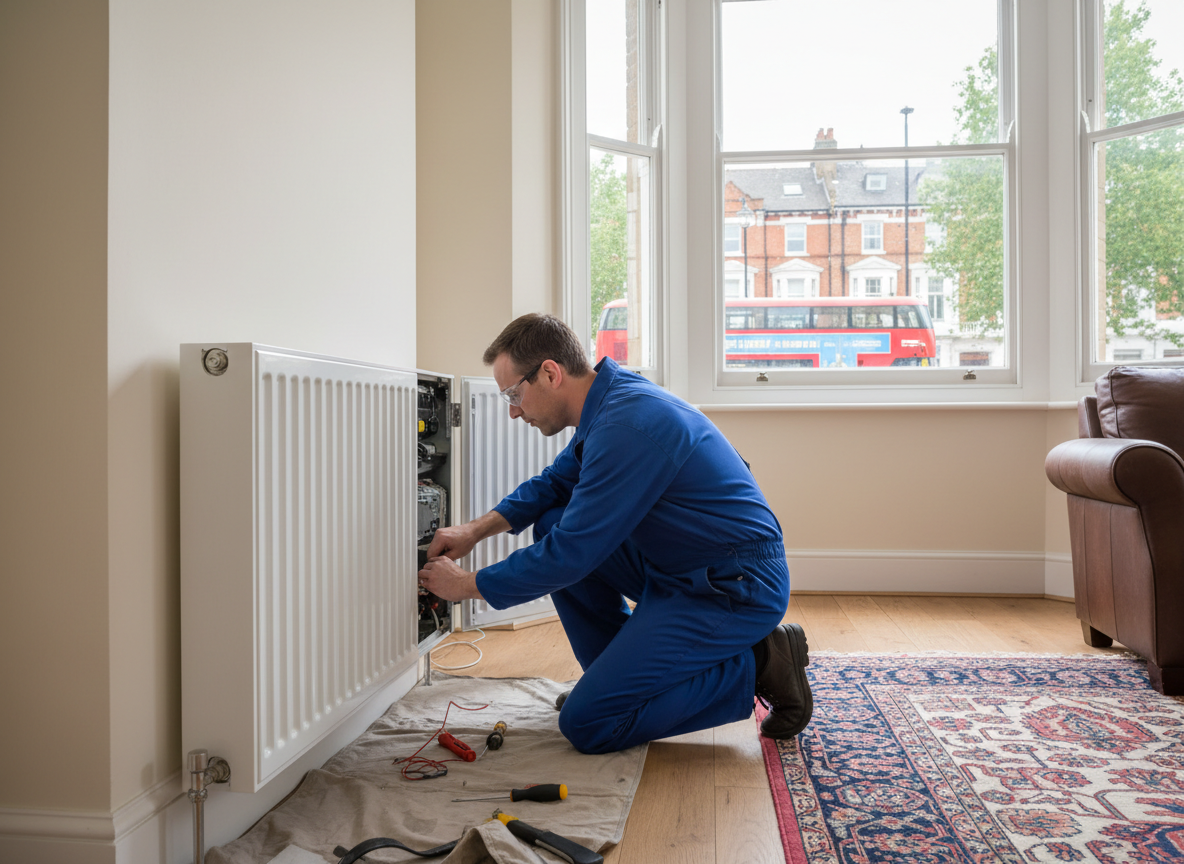
London's housing stock ranges from Victorian terraces in Islington and Camden to 1960s council blocks in Holloway, each presenting distinct challenges for electric radiator repairs. Older properties often carry original wiring that has degraded over decades, leading to loose connections or overloaded circuits when modern radiators are added. Damp conditions common along the Thames corridor accelerate corrosion on metal elements and thermostats, shortening component life and increasing the chance of intermittent faults.
Repair work here frequently involves isolating the circuit at the consumer unit before testing resistance and insulation values with a megger. In flats above shops or in converted warehouses, access to trunking and junction boxes can be restricted by later alterations, requiring careful tracing of cables that may run through multiple floors. We check for neutral-earth faults that are more common after repeated heating cycles in properties with aluminium wiring from the 1970s.
Seasonal demand spikes during the first cold snap in November when overnight temperatures drop below freezing, exposing weak points in radiator thermostats and time clocks. Homeowners in North London terraces often report radiators that heat unevenly because air locks have formed after years of topping up system pressure without bleeding valves correctly.
We carry common spares such as replacement elements, capillary thermostats and relay boards for popular models fitted in the 1990s and 2000s, allowing most repairs to be completed on the same visit without ordering parts from suppliers in Enfield or Croydon.
Technician insight
In London, the thing that catches most people out with Electric radiator repair service is the mix of original 1930s rubber-insulated cable and later 1970s aluminium runs hidden behind plaster in Islington terraces; one loose neutral in the junction box can make a radiator appear completely dead even when the element itself is fine.
Intermittent Fault in Holloway Flat
A top-floor flat in a 1970s block near North Road showed one radiator cutting out after twenty minutes. We found a degraded thermostat capillary tube that had fatigued from repeated expansion cycles in the unheated stairwell. The part was swapped on site and the circuit retested for insulation integrity.
How it works
- 1
Initial Assessment
We arrive at your property in London, isolate the circuit and inspect the radiator, wiring and controls for visible damage or overheating.
- 2
Fault Diagnosis
Using multimeter and insulation tester we measure element resistance, thermostat operation and earth continuity to pinpoint the exact failure.
- 3
Component Repair or Replacement
Faulty elements, thermostats or relays are replaced with compatible parts while preserving the existing radiator body where possible.
- 4
Testing and Handover
The circuit is re-energised, the radiator is run through a full cycle and we confirm even heat output before leaving the property safe.
Pricing
Clear upfront quotes provided on site after diagnosis; no hidden call-out fees for 24/7 London work.